The 2 Variables That Make or Break Your Career Pivot
Career Pivot Theory: Know your 2 variables (Job vs. Network) to make an easy pivot because you are probably making it harder than it should be. But learn my strategy to change both, including a LinkedIn hack to skip the line.

"If you were to ever write a book, it will be about that right there."
This was a comment from a stranger after a short meeting with them about their career. It was a few years ago, and I was talking to them because they had applied to an open software development position I had on my team. I had not selected the person for an interview based on their experience (it didn't align to what I was looking for) but since they were an internal candidate, I offered them a conversation to learn about them and their goals to see if I could still help them. This was a common thing I would do because as a software manager, I had a lot of people wanting to make a career pivot into software, such as this person. I also was building new teams and was one of the few managers hiring so I was getting lots of interest. So I would use this time to get to know them, educate them on the various types of software teams in the company, and try to steer them in a direction that would be best for them.
For this specific conversation, their situation was this: they were a project manager for a vehicle feature software development team. So they didn’t develop software, but they were learning how to on their own because they wanted to move into software development as their next career pivot.
After maybe ten minutes or so I learned that their dream job in the next few years was to be a software developer for the current feature he was supporting as a project manager. It was then that I realized I needed to share my pivot what you do vs pivot who you do it with theory. Now, I do not believe I came up with this idea but I have no idea where I heard it and I have been refining it for many years to the point that I can't remember when and where the concept started, but it goes like this.
When you are looking to transition your career from one thing to another you can either a) change what it is you are doing (aka your job) or b) change where you are doing your work (aka your network). If you try c) changing your job and your network, that is when things get really hard. Possible. But hard. To put it in a visual, these are your options when thinking about a career change:
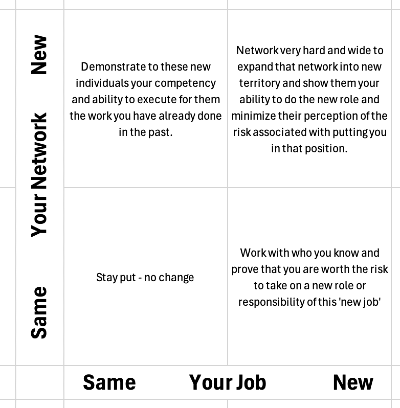
For clarity, a job is a specific skill, knowledge, or experience you have demonstrated competency in. A network is a group of people you know or have gotten to know well enough that they could help you.
This individual was not a software developer (their job / what they do) but they wanted to become one. So they were looking to join my team (network / where they do their job) but this meant they were trying to change both variables. Don't get me wrong, this is not impossible; I have done it. But more times than not, my career change was one of the two variables, not both.
His rationale was that he would go and learn software development in another area and once he was comfortable, he would go back to where he really wanted to be. I explained that the easiest way to do this was actually to stay where he was and learn how to be a software developer on his current team, which fortunately for him was also his dream team. That is because that is the network he already has (he knows people, likely the manager of the software development team too), and those people are much more likely to take a "risk" and hire him for a job he has never done before because they know him. For me to hire him, that is too risky because I don’t know him and he didn’t have a proven track record of knowing how to do the job I was hiring for. Again, this is not impossible for someone. I have indeed hired people who have not done the job I was hiring for (exactly) nor were they people I knew, but it was times and situations where the reward (the potential I saw in them) was worth the risk (lack of experience, lack of proven track record with me personally).
This is when the lightbulb turned on for him and he realized the answer did not lie within me, but in himself. It was this realization, that he had been overcomplicating his path by trying to change both things, that he considered the golden nugget of information, and why he said I should write a book on this subject.
If you are not convinced of this, let's talk about some more examples from my career.
I started off as a process improvement engineer in healthcare. I was a generalist working across the various departments of the hospital. There was an opening for a process improvement engineer in the department of surgery (operating rooms). I had not yet worked in this environment, didn't even like the idea of surgery, and therefore had no real experience to stand on. However, I wanted the job because the operating rooms are where money is made, and if you want a good career, work in the departments that make the most money. So, I did that and got the job. I didn’t change what I was doing (process improvement engineering) but I did change my network (the people I worked with and for in the operating rooms).
After a year or so of doing this job, there was an opening for the IT administrator for the operating rooms. I had no formal experience in this as a process improvement engineer, but it was something I was interested in pivoting into. However, as a process improvement engineer, I had gotten to know the IT systems well as they were central to many of the core processes of the department. I was able to do this because I stayed within my network (I knew the hiring manager and everyone I would be working with, and the administrator believed I was the right person) so they were willing to take a chance on me, who didn’t have the experience, because they knew me as a person and saw potential in me.
Now the time came in my career where I was ready for a big pivot. I had completed my graduate degree in cybersecurity and I wanted to work in Automotive Cybersecurity (this was a far cry from a process improvement engineer or healthcare IT manager). This means I was looking to do two things: change my job (moving from process/IT skills to cybersecurity knowledge) and change my network.
The last big pivot I did, before the big pivot to entrepreneurship, was to become a software development manager. At the time, I hadn't personally coded in over 15 years and the IT software management work I did in healthcare was not of developers per se, but more configurers of a SaaS product. So how did I do it? By going for a position where I knew the hiring manager well because we worked together in prior roles. So in this case, my lack of being a software development leader, or a software development individual, and never have been a people leader in the current company, was not what got me the job (I was not changing my network and staying in a job). It was the fact we were in the same network and I had proven myself to them and that is why they hired me for a job that I had not had a proven track record in.
To wrap these examples up, let's also look at an example of my biggest career pivot to date: leaving corporate for entrepreneurship. When I left to acquire a business, I had no experience doing this (so I was changing "jobs") but I quickly partnered with two other individuals that I knew (my network). Had I stayed on my own, or tried to partner with people with no established relationship, things could have turned out much different.
Compare that now to my Radio Chatter endeavor. Sure I don't have entrepreneurship experience, but I do have experience in the off-road and overlanding space as both an individual who participates in the hobby but also as a trail guide for Mountain State Overland, which has their own networks that I now belong to. Had I started a business in another industry, say the fitness industry, I have no experience (job) nor network (I don't belong to clubs or gyms) so that would be a harder time for me to build a company and reputation in.
So what is the secret sauce when you want to do both?
Networking, networking, networking.
The days of applying to jobs and thinking that the best candidate on paper will get an interview are gone. Because there are too many people with nearly identical experiences to interview all of them. So to make myself stand out specifically when I was moving from healthcare to automotive, I did the following:
- I reached out to a local automotive cybersecurity conference that was coming to town. I told them I was looking to move from healthcare to automotive but didn’t have the funds to attend all these conferences so I offered to volunteer in exchange for a ticket. Surprisingly, all they asked for was another email but this time from my healthcare email to prove my story to be credible and they would give me a ticket for free. I did exactly that. At that conference, I met a lot of people and got my resume to at least one that I was able to connect with when a position at a company opened up and they happened to know the hiring manager so they happily sent my resume over to them.
- I found two old professors of mine that worked for the company I was looking to get into so I connected with them, they remembered me, and offered to also connect with the hiring manager. I did this with a couple people via LinkedIn too who worked for the company and when all was said and done and I finished the interview for the position, the hiring manager told me that no less than four people had contacted them about me. That's networking and as a hiring manager, I can tell you that if multiple people give me someone's name or resume, they are going to get an interview. Maybe not the job, but for sure an interview.
These methods are how I made a big change possible. If you are also looking to change both your job and your network, there are other things you can do to stand out. For example, a hack on LinkedIn that a lot of people don't know exists is you can often find the hiring manager or HR professional, or even team member, of a position that is posted on a company website. Here is how you do it:
- Find a position you are interested in on a company's website
- Take the title (or even a unique job ID if it is in the title) and go to LinkedIn to perform a search
- Enter the terms in the search field (you will get a lot of useless results so keep following my instructions)
- Click on 'all filters' and make sure you are filtered only on 'posts' and where the 'author company' is the same company that has the job opening.
That this shows you is anyone from your desired company that has posted about that position. Often times it looks like this:
- Hiring manager: "I'm hiring, come join my awesome team!"
- HR Manager: "I'm helping [hiring manager] hire, DM if interested!"
- Team member: "Our team is hiring and our boss is amazing, join us!"
The team member one is the secret here. Compared to the HR or hiring manager, the team member likely has the most amount of time to talk to you and the least amount of people messaging them about the job. So talk to them and impress them and they will often sell you to their boss: "Hey, I had a call with this person and they seemed really great, you should talk to them about our position we have open." I could write a whole blog post on this, but the key thing here when I say impress them, I don't mean talk their ear off and show off, it is not an interview. Ask questions, learn about them and let them do most the talking. I don't have the research handy, but there have been studies that show that people have more favorable impressions of people they interact with when they feel listened to rather than feeling talked to. So listen to them, hear them, and throw in a little bit of your experience and knowledge via the questions you ask and the discussion you have.
I have done this LinkedIn search for other people and I'd say it works 80% of the time (not scientific). It works the best at big companies (Microsoft, Nvidia, etc.) and the least for small companies (non-profits) because the big companies are on LinkedIn much more than the smaller companies.
I've also had talks with team members instead of hiring managers and I have learn a ton about the role and company. In one case, I was told 'Do not apply for this job, I am leaving and you will hate it here.' Talk about saving me a lot of headache!
Now that you've seen the matrix: Which pivot are you pursuing next? Are you making the EASIEST pivot (new job, current network) or tackling the HARDEST one (new job, new network)? Share your biggest challenge below or email me - I'll respond with my thoughts!